

In November, I had a rather “out-of-place” but incredibly valuable experience. I attended DevFest Busan 2025, a major technology event. Imagine a marketer—not a developer—suddenly dropped into a space filled with programmers, surrounded by the sound of rapid keyboard typing, screens full of code, and passionate discussions about APIs, frameworks, algorithms… My first feeling was truly overwhelming.
Amid the energetic atmosphere, one keyword kept popping up with remarkable excitement: Flutter. At first, I simply thought, “Ah, just another technical term—not related to me.” I planned to ignore it and focus on topics that sounded more “marketing-like.”
But then the “Wow!” moment happened. When I listened more closely, I realized the discussion about Flutter wasn’t just about code. When they talked about Hot Reload, my ears didn’t hear “code”—I heard “real-time A/B testing of app landing page UI.” When they mentioned single codebase, I didn’t think about software architecture—I immediately understood it as “cutting the app development budget in half to allocate more funds for the upcoming marketing campaign.” Suddenly, those seemingly dry technical concepts hit right at the core concerns of any marketer: budget, customer experience, and speed to compete.
Today, I want to “decode” Flutter from a marketer’s angle—to explore why this technology isn’t just a joy for developers, but also a strategic advantage business leaders should understand.

. What is Flutter? A simple explanation for non-developers
I’ll explain this in the simplest way possible—no coding knowledge required.
Flutter is an open-source UI development framework created by Google.
Still sounds a bit technical, right? Try this analogy:
Imagine you want to build a house on two different plots of land—one in the “iOS kingdom” and one in the “Android kingdom.” Traditionally, you must hire two separate teams, each speaking a different “language” and using different tools. Very costly and time-consuming.
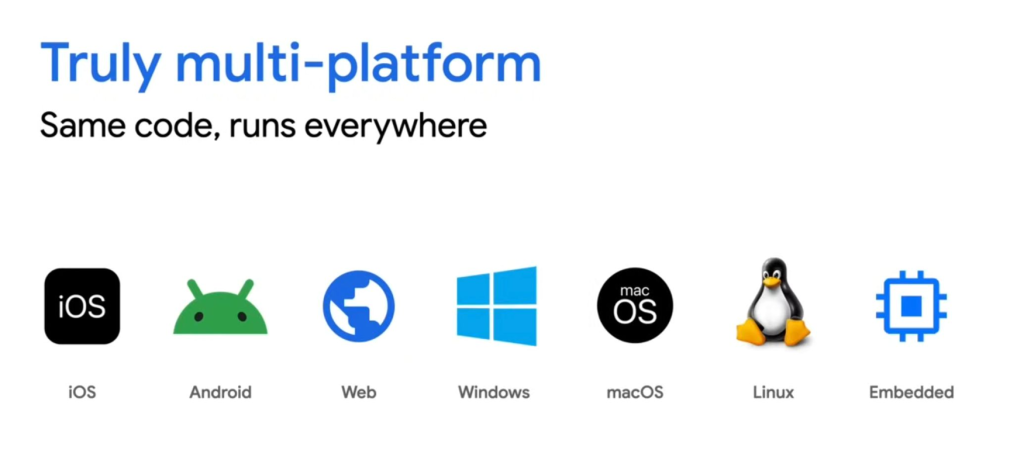
Flutter appears like a magic construction team. You give them just one blueprint, and they can build identical houses on both plots. This is Flutter’s core value: the ability to build apps for mobile (iOS, Android), web, and desktop using a single codebase. In other words: “Write once, run everywhere.”
This transforms Flutter from a mere technology into a strategic resource optimization solution, helping businesses save significant time, money, and effort.
2. Insights for Marketers: Why should we care about Flutter?
Reports from many businesses using Flutter show they can launch products up to 50% faster.
For marketers, this has huge strategic implications. Launching a product or feature faster than competitors is a tremendous advantage. Moreover, Flutter enables simultaneous release across platforms—a critical factor in campaigns requiring synchronized timing across markets, helping us capture the market and gather early user feedback.
3. Marketers don’t need to code—but we do need to “touch” technology
After my “lost” trip to DevFest, I realized something important: as a marketer, I don’t need to know how to code. But understanding the essence and business value of technologies like Flutter is an advantage we cannot ignore.
This understanding prevents us from standing on the sidelines during product discussions. It allows us to collaborate more effectively with technical teams, request feasible product changes, and build smarter, more practical marketing strategies. It tears down the invisible wall between Marketing and Tech, creating stronger synergy.
The world is changing, and boundaries between fields are fading. A marketer who is curious about technology—and a developer who understands business—will always be the ones who create the greatest value.
4. 3 Reasons Why Flutter Is Good News for Marketers
1. Budget Optimization
Instead of maintaining two separate development teams for iOS and Android, businesses only need one team. This significantly reduces development and personnel costs. Furthermore, companies using Flutter report up to 30% lower maintenance costs.
2. Smooth Performance
Unlike some other cross-platform technologies, Flutter compiles directly to native machine code. This ensures smooth performance and responsive interaction—nearly equivalent to native apps. Users experience seamless scrolling and transitions, leading to higher satisfaction.
3. Unified Brand Experience
This is my favorite point. Since Flutter “draws” its own UI instead of relying on native OS components, it ensures a fully consistent interface and user experience across all devices—from the newest iPhone to a mid-range Android phone.
This consistency builds trust and strengthens brand identity.
A great example is BMW: they previously faced feature fragmentation between Android and iOS versions, causing negative user feedback. After switching to Flutter, BMW eliminated all discrepancies and delivered a premium, unified experience in 47 countries.
If you enjoy insights at the intersection of data, technology, and marketing, feel free to explore more articles on my personal website — where I document my learning journey to become a data-driven marketer.