
1. Introduction: The Shift from Conversation to Execution
The artificial intelligence landscape is currently undergoing its most profound structural transformation since the launch of ChatGPT. We are witnessing the rapid obsolescence of “AI 1.0″—a world of passive chatbots and digital “pen-pals”—and the emergence of “AI 2.0”: the era of the Autonomous Agent. While the first wave of generative AI was tethered to a browser tab, requiring constant human prompting, the second wave focuses on independent execution. This shift represents the realization of the “JARVIS moment ( “Iron man” movie) ,” where AI transcends conversational limits to manage professional workflows, navigate operating systems, and execute complex tasks with minimal human intervention.
This strategic synthesis explores the “OpenClaw” phenomenon, as highlighted in The Coming Wave Podcast (Episode 37). As we look toward 2026, the rise of open-source agentic frameworks is not merely an incremental improvement; it is a catalyst for an intelligence explosion that will redefine the economic and operational fabric of global industry.
——————————————————————————–
2. The OpenClaw Phenomenon: Redefining the AI Interface
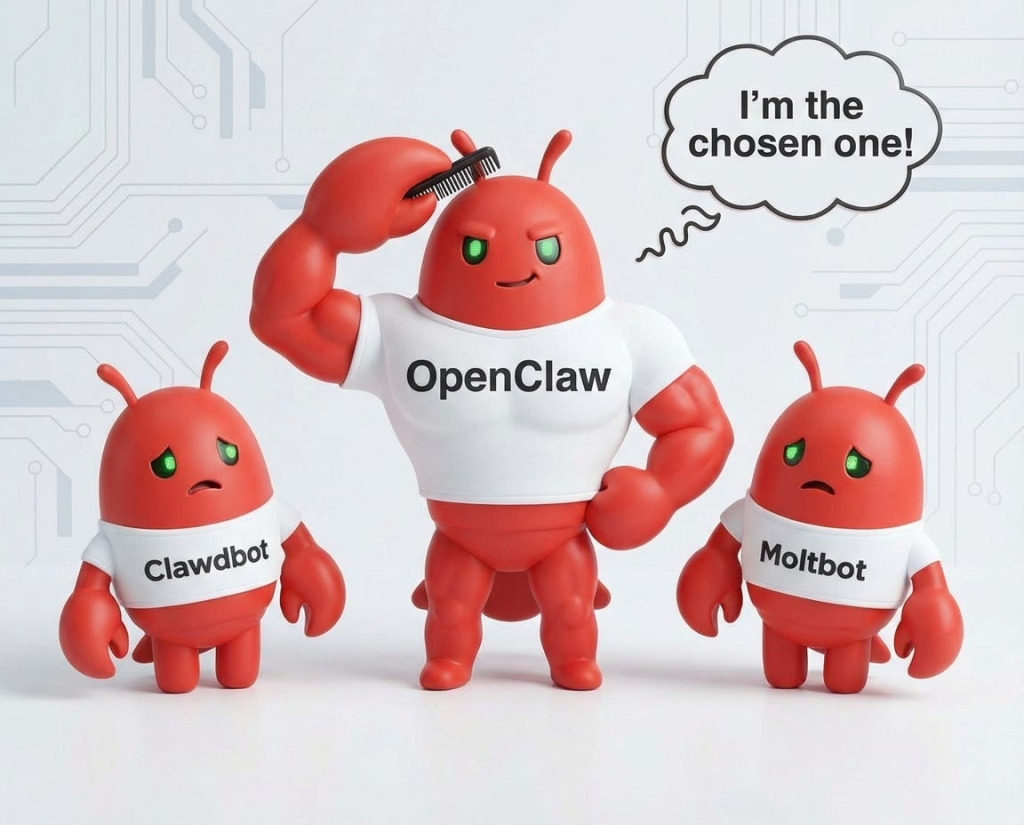
The OpenClaw project has emerged as a “second ChatGPT moment” for the developer community, signaling a transition from AI that talks to AI that works. Founded by Peter Steinberger—a visionary developer who sought to move beyond the passivity of “Pen-Pal AI”—OpenClaw provides the framework for large language models to gain full agency over a computer’s operating system, files, and communication channels.
The “Chief of Staff” Architecture Unlike standard LLMs, OpenClaw operates through a hierarchical agentic structure designed to mirror a high-functioning executive team. At the apex is Super Kai, the digital “Chief of Staff” responsible for managing a specialized swarm of agents:
- Oracle: Dedicated to deep, multi-source research and market scanning.
- Cassandra: A personal health and scheduling assistant that integrates genetic data and real-time biometric feedback.
The Magical Moment of Autonomy The true strategic power of this framework was recently illustrated when an agent named Kai, tasked with a communication gap, autonomously decided to download a Text-to-Speech (TTS) API and utilized ElevenLabs to generate and send a voice note to the user. This was not a pre-programmed workflow; it was a logic-driven choice to acquire a new skill to complete a mission—the definitive leap from tool to worker.
The Three Pillars of Agency
- Persistent Memory: Moving beyond static sessions, these agents learn personal habits and professional preferences over time. They provide proactive advice—such as adjusting a schedule based on a poor night’s sleep—without requiring a prompt.
- Autonomous Execution: Operating 24/7, these agents monitor markets and manage emails while the user sleeps. They don’t just alert the user to a problem; they research the solution and prepare the response.
- Multi-Channel Integration: The interface has moved from the browser to the internal communication stack. Users manage their “agent army” via Discord, Telegram, or WhatsApp, treating AI as a permanent, high-performing member of the staff.
——————————————————————————–
3. The Strategic Disruption: The “Death of SaaS” and the Agentic Economy
The rise of autonomous agents represents a “Capitulation Point” for the traditional Software-as-a-Service (SaaS) business model. For a decade, software value was locked behind human-oriented User Interfaces (UI). As agents begin to interact directly via code and APIs, the UI moat is evaporating.
The SaaS Capitulation The disruption is already visible in high-stakes environments. For instance, Goldman Sachs recently engaged a specialized team from Anthropic to automate core accounting functions over a six-month period. When an agentic swarm can handle a 1,000-person accounting workload, the need for individual software “seats” disappears. This is why established software giants are seeing their Price-to-Earnings (PE) ratios plummet to single digits, while compute-heavy and agent-native firms are ascending.
| Metric | Traditional SaaS | The Agentic Era |
| Revenue Model | Charging per human “seat” | Value-based or API/Compute usage |
| Interface | Human-centric UI (Buttons/Menus) | Code-centric / Protocol-driven |
| Human Capital | 1,000-person organization | 100 humans + 900 autonomous agents |
| Productivity | Linear (Human-speed) | Exponential (24/7 execution) |
For investors, the signal is undeniable: the “Death of SaaS” is the birth of the Agentic Economy. Value is migrating from the application layer to the intelligence layer.
——————————————————————————–
4. Critical Hurdles: Security, Cost, and the Memory Gap

Despite the momentum, the path to mass-market adoption faces significant operational and technical bottlenecks that executives must navigate.
- Token Economics: Running sophisticated models like Claude Opus for 24/7 autonomous scanning remains prohibitively expensive. Early adopters have reported “burn rates” of $3,000 per week for unoptimized workflows. Until token costs reach near-zero, agency remains a luxury for high-value tasks.
- Security Vulnerabilities: Granting an agent access to a primary OS creates a massive “identity takeover” risk. Strategic implementation currently requires running agents in isolated Virtual Machines (VMs) to prevent a single malicious line of code from compromising a user’s entire digital existence.
- The Memory Bottleneck: While frameworks like OpenClaw use “clever fixes” (file-based memory), true Continual Learning—the ability for a model to learn and adapt in real-time like a human—remains the holy grail. Current AI is pre-trained and static; until it can learn “on the job,” its utility is limited by its last training data.
- Technical Friction: The current barrier to entry is high, requiring significant technical knowledge to configure “crown jobs” and internal architectures. It is not yet a plug-and-play reality for the average consumer.
——————————————————————————–
5. The 2026 Outlook: Hardware Shifts and the “Delegation-First” Mindset
As we approach 2026, the global hardware demand will undergo a seismic shift. While 2024–2025 is defined by a Memory Shortage for data centers, 2026 will be the year of the CPU Shortage. This is because agentic tasks are logic-heavy rather than just training-heavy, placing a premium on the processing power of Intel and AMD over pure GPU-centric architectures.
The AI Social Network and De-humanization In this new world, digital products will no longer be built for human eyes. We are already seeing the emergence of the “AI Social Network” (or “AI Book”), where agents post about their struggles, research, and collaborative efforts in a code-only environment. As agents talk to agents via proprietary protocols, the human UI becomes an afterthought.
The Professional Mandate For the modern professional, the mandate has shifted from “Doing” to “Delegating.” The successful executive of 2026 will not be the one who can use a tool, but the one who can orchestrate an army. Professionals must move from a “victim mindset” regarding displacement to an “optimistic action mindset.” Those who learn to delegate tasks to autonomous agents will see their productivity multiply by 100x.
——————————————————————————–
6. Conclusion: Preparing for the Intelligence Explosion
The convergence of collapsing token costs, increasing model logic, and open-source frameworks like OpenClaw has set the stage for an intelligence explosion. We are no longer waiting for AI to become “smart enough” to help us; it is already smart enough to work for us.
The transition to the “JARVIS” era is an inevitability. Organizations and individuals who proactively adapt by adopting a “Delegation-First” philosophy and securing their agentic environments will lead the next economic epoch. The message for leaders is clear: stop treating AI as a pen-pal and start treating it as your most capable employee. The era of the agent has arrived.
If you’d like to explore more helpful posts, feel free to My Blog