
Throughout the long arc of human history, our identity has remained tethered to the unique pedestal of our intelligence—the singular ability to reason, to create, and to manipulate the world around us. We have successfully navigated three industrial revolutions, each shifting the burden of physical labor from muscle to machine, yet always retaining a human monopoly on the cognitive steering wheel. That monopoly is now ending. We are approaching a threshold where the boundary between human identity and machine capability is not merely blurring; it is being fundamentally restructured. The tectonic plates of cognition are finally snapping. The strategic landscape of 2025 served as a series of seismic tremors, but 2026 represents the year of “The Great Sifting.” This is the era where the digital intelligence we have nurtured in silicon spills over into the physical world, demanding a radical re-evaluation of what it means to be a professional, a creator, and a participant in the global economy. This shift represents the final barrier in the economic landscape, an era where the “miracle of the human hand” meets the “miracle of the silicon brain” to create a reality that feels less like a tool-use transition and more like a phase shift in human existence.What followed was not just internal change, but a full-scale Google AI strategic transformation.
Retrospective: The Titans and the Infrastructure of 2025
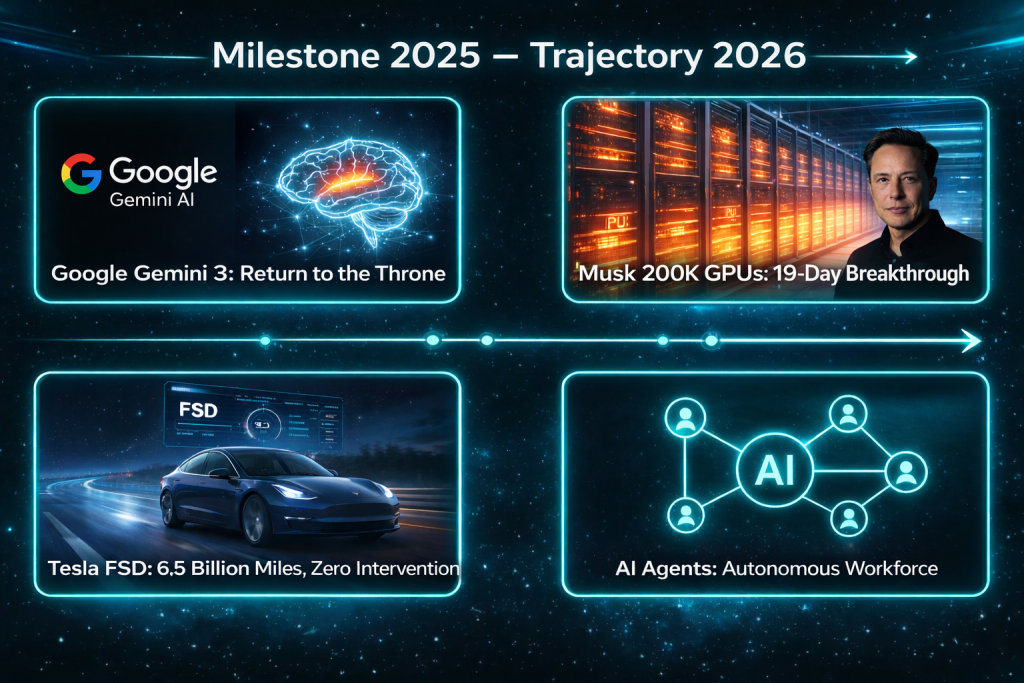
To chart the trajectory of 2026, we must first diagnose the foundational milestones of 2025—a year that dismantled the skepticism of the early 2020s through sheer engineering force. It was the year of the “Return of the King” for Google. Long dismissed as a sluggish incumbent, Google reclaimed the throne through the Gemini series. By the release of Gemini 3, the company proved the superiority of a natively multimodal approach, demonstrating an uncanny ability to process text, audio, images, and music simultaneously. This wasn’t an incremental update; it was a reclaiming of the AI hierarchy. Yet, the most visceral display of the new “logistics of intelligence” came from Elon Musk. The construction of a massive data center housing 200,000 GPUs in a staggering 19 days was a feat Nvidia CEO Jensen Huang explicitly labeled “superhuman.” In a world where such infrastructure typically requires a four-year cycle of planning and power negotiation, Musk’s 19-day sprint rendered traditional government and corporate timelines obsolete.
This infrastructure explosion fueled the maturation of Tesla’s Full Self-Driving (FSD) technology, which reached a state of terminal utility by late 2025. With cumulative autonomous mileage surpassing 6.5 billion miles, the milestone of a coast-to-coast journey from Los Angeles to New York—achieved without a single human intervention on the steering wheel—signaled that autonomous agents had transitioned from laboratory experiments to real-world infrastructure. Simultaneously, the birth of agentic workflows, epitomized by Anthropic’s Claude Code, transformed AI from a passive assistant into an active laborer. These boots-on-the-ground insights, corroborated by practitioners like Nguyễn Mạnh Linh of Resident Technology who build AI for international markets, confirm that the “human-in-the-loop” model is rapidly decaying in favor of autonomous execution.
The Geopolitical and Economic Undercurrents
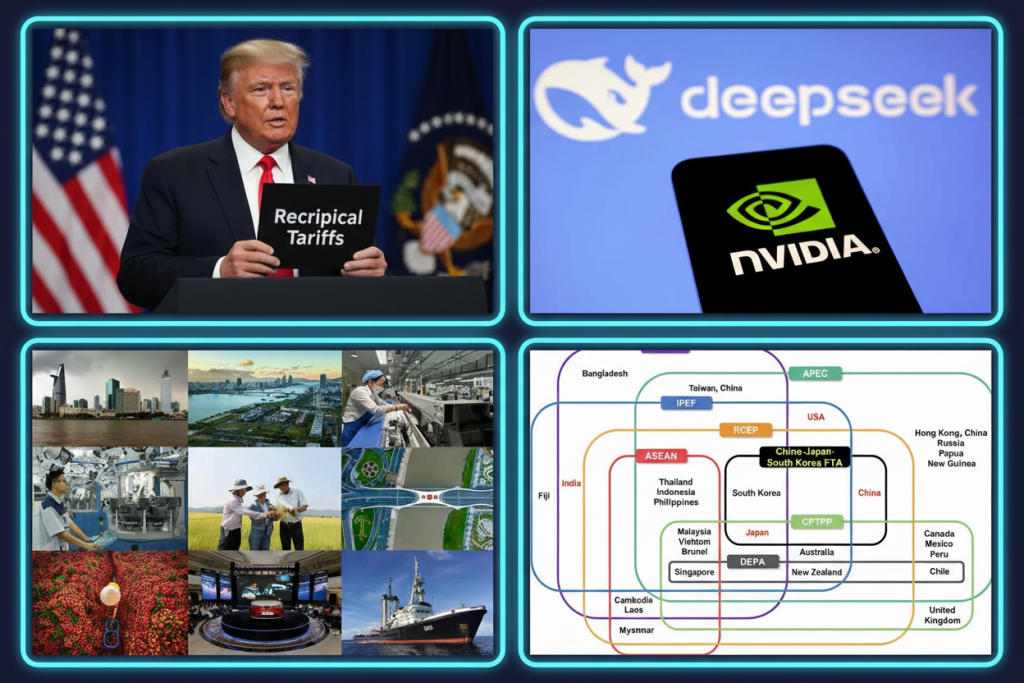
The technological surges of 2025 did not occur in a vacuum; they were forged in a volatile geopolitical furnace. The year was defined by “Liberation Day,” a period of aggressive tax and tariff shifts under the Trump administration that sent shockwaves through the global supply chain. This environment created unprecedented market turbulence, particularly during the DeepSeek event in January 2025, which saw American chip giants like Nvidia lose hundreds of billions in market cap in a single Friday. This was the era of “múa bên trăng”—the Vietnamese term for the “empty buy side”—where liquidity vanished during panics, leaving even seasoned investors paralyzed. This phenomenon served as a precursor to the 2026 mandate for strategic adaptability; those who could not navigate the “empty side” of the market were sifted out.
Against this backdrop of global volatility, specific regional upgrades signaled a shift in the economic order. Vietnam’s historic transition from a frontier market to an emerging market status, expected for its final March confirmation, illustrated the rising importance of Southeast Asia in the AI-driven supply chain. For strategic observers, the lesson of 2025 was clear: the old world order was being replaced by a more fluid arrangement where technological prowess and economic policy are inextricably linked. This forced a massive shift in investment behavior, moving away from speculative “chatbot hype” toward a rigorous focus on the hardware-software convergence and companies that could demonstrate verifiable utility in an AI-dominated landscape.
Prediction I: The Arrival of Production-Level Intelligence

As we enter 2026, the most visible shift is the transition from “Chatbots” to “Production-Level” intelligence. To grasp this leap, one must look at the evolution of generative media. In late 2022, the world mocked the amateurish, distorted clip of Will Smith struggling to eat spaghetti. By 2026, those hallucinations have been replaced by Hollywood-tier realism. Models like Google’s Veo 3.1 have achieved a level of audio, video, and music output that is indistinguishable from professional human productions. This is no longer “generative art”; it is industrial-grade media production available to the masses.
This transition creates a “Price vs. Intelligence” paradox. While cognitive capability is scaling exponentially, the cost of that intelligence is plummeting into the realm of the negligible. A model that today costs pennies to operate is ten to twenty times more capable than the most expensive flagship models of 2024. This commoditization of creativity means that specialized technical skills—the ability to edit a frame, mix a track, or render a texture—are no longer the gatekeepers of professional output. For the non-specialist, the power to create at a world-class level has been democratized, shifting the value of a professional from their “skill” to their “vision” and “taste.”
Prediction II: The Conquest of the Verifiable
The second major shift of 2026 is the rapid displacement of labor in fields with “binary” outcomes—industries where answers are strictly right or wrong. Through the aggressive application of Reinforcement Learning (RL), AI is conquering accounting, trading, and auditing. Unlike creative writing, which is subjective and prone to drift, the tax code and financial markets provide a rigid framework for RL to iterate through millions of simulations until it achieves 100% accuracy. This “verifiability gap” is the strategic differentiator that determines which industries fall first.
This technical reality explains the existential crisis facing the traditional Software-as-a-Service (SaaS) business model. Giants like Adobe, despite their massive enterprise contracts and current profitability, face deepening investor concern because “World Models” can now perform the tasks that once required a suite of expensive, specialized software. When a task is verifiable, an AI can be trained to reach near-perfect accuracy with zero fatigue, making it more efficient and reliable than a human junior analyst or accountant. Consequently, insurance underwriting, legal document review, and high-frequency trading are being absorbed into the domain of autonomous agents, leaving human professionals to focus solely on the high-level architecture of these automated workflows.
Prediction III: The Scientific Breakthrough and the Dawn of AGI
Perhaps the most profound transformation in 2026 is the shift of AI from a “knowledge recycler” to a “scientific discoverer.” Historically, AI was trained on human data, effectively summarizing what we already knew. Today, AI is winning gold medals at the International Math Olympiad by reasoning through novel problems it has never seen before. In biology and chemistry, AI is compressing decade-long R&D cycles into months. By simulating reality at the molecular level, tools like Google’s AlphaFold 3—the foundation for Demis Hassabis’s Nobel Prize—are identifying drug candidates without the immediate need for years of animal or human testing.
The US Food and Drug Administration (FDA) has already begun moving toward guidelines that favor mathematical and simulation-based verification to address ethical and cost concerns. This ability to simulate protein folding and chemical reactions at the scale of 100x human speed allows for breakthroughs in materials science and medicine that were previously unimaginable. This is the first true evidence of Artificial General Intelligence (AGI): the capacity for creative, novel discovery. Once AI can simulate the complex dance of biology and chemistry in the digital realm, the next logical step is the manipulation of the physical atoms it has just finished simulating.
Prediction IV: Crossing the Rubicon into the Physical World
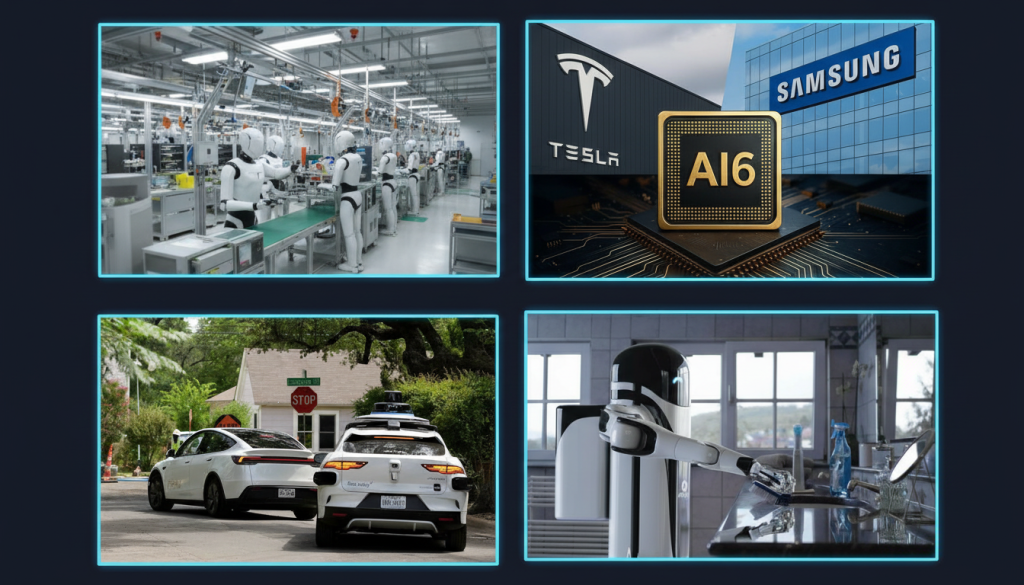
The culmination of these advancements is the move from the digital screen to the physical world. The breakthrough of “World Models” has finally solved the “robotics bottleneck”—the inability of machines to perceive and react to a messy, unpredictable factory floor or kitchen. By integrating the reasoning of large models with physical sensors, we are seeing the rise of truly dexterous humanoid robots. The convergence of Tesla’s AI6 chip—a unified brain for both the Optimus humanoid and the autonomous vehicle fleet—is the final piece of this physical puzzle.
In 2026, the car is being redefined as an “earning vehicle.” We are entering a reality where a vehicle can drop its owner at work and then spend the day functioning as an autonomous taxi, generating revenue before returning to pick up its owner. In cities like those in Texas, we expect to see 10,000 to 20,000 of these autonomous vehicles operating at a single time. This leap into the physical economy is poised to create the world’s first official trillionaire, as the value of autonomous labor and transport begins to dwarf the traditional software economy. The “miracle of the human hand”—the dexterity we once thought was our final refuge—is finally being replicated in silicon and steel.
The Death of the Junior and the Architect’s Mandate
This technological surge brings a somber, structural obituary for the labor market: the death of the “Junior” position. Entry-level roles that once involved “Long Horizon Time Tasks”—tasks requiring 4 to 8 hours of focus, such as social media management, basic coding, or data entry—are now fully automated. A manager no longer needs an intern to draft reports or write social posts when an AI can execute these outcomes better, faster, and for free. This represents a fundamental break in the career ladder. Traditional degrees are losing their signaling value because the “skills” they teach have become commodities.
The professional of 2026 must transition from a “task executor” to an “AI Workflow Architect.” The value is no longer in knowing how to use Excel or write a basic Python script; the value is in the ability to manage a “Portfolio of Outcomes.” A single individual can now oversee a dozen AI agents to build a software product, manage a marketing campaign, or conduct a scientific study. Career sustainability now depends on the ability to architect complex processes rather than executing individual steps. We have moved toward an outcome-based economy where the ability to self-learn and adapt is the only currency that retains its value.
Conclusion: The Survival of the Adaptable
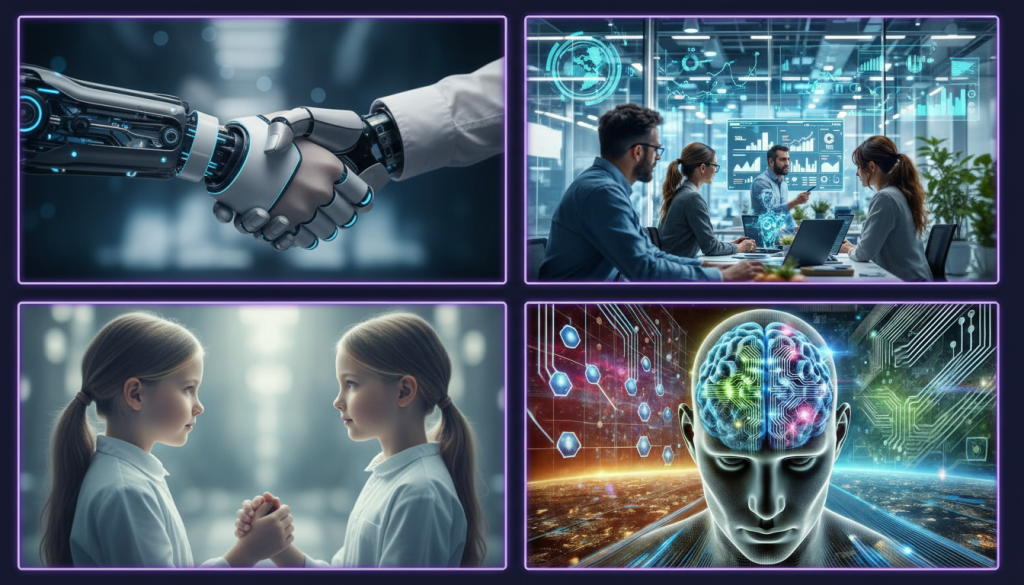
As we look toward the horizon of late 2026, the strategic imperative is clear: adaptability is the ultimate asset. The unresolved tensions between our rapid technological power and our societal readiness will define the coming decade. While the death of entry-level roles is a moment of profound disruption, it also represents a moment of unprecedented individual power—a time when one person, armed with the right AI workflows, possesses the creative and productive capacity of a mid-sized firm.
The miracle of the silicon brain does not diminish the value of human existence; it forces us to elevate it. In this new era, we are no longer defined by the repetitive tasks we can perform, but by the visions we can realize. To survive the 2026 shift, one must stop competing with the machine and start architecting the world the machine makes possible. The power to create anything is now within reach, provided we have the courage to let go of the old definitions of work and identity. The Great Sifting has begun; only the adaptable will remain.
Thank you for reading my article all the way to the end — I truly hope you found it valuable and insightful.
If you’d like to explore more helpful posts, feel free to My Blog