
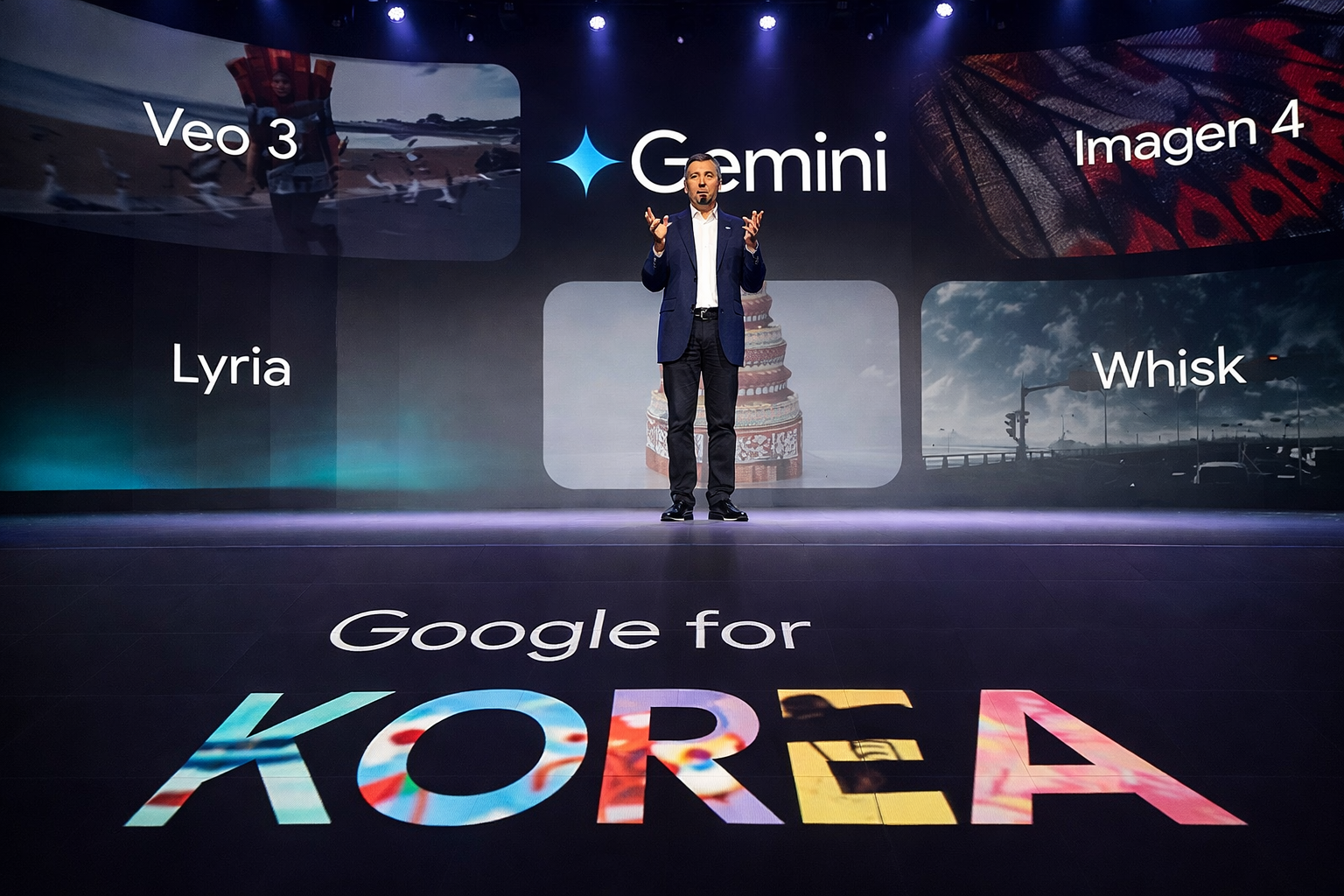
1. The Dawn of the “AI-First” Epoch The Competitive Reality of the Google Gemini AI Business Model in South Korea
The global digital order is currently undergoing a violent re-architecting. We are witnessing the twilight of the mobile-centric era and the dawn of an “AI-First” epoch—a transition that is less a technical update and more a foundational restructuring of how humanity interacts with the digital fabric. For Google, this is a scorched-earth pivot. By abandoning the “Mobile First” mantra that defined the last decade, Mountain View is forcing a total organizational migration toward a future where generative intelligence is the primary interface. This led me to explore the Google Gemini AI business model in South Korea — a market where technology, regulation, and cultural identity collide in fascinating ways.
Google’s strategic moat in this new era is built on a dual foundation of unmatched research volume and proprietary infrastructure. With a portfolio of 187 distinct AI models—the largest in the industry—supported by a custom TPU (Tensor Processing Unit) architecture, Google has created a vertical integration that optimizes both performance and training costs. The launch of the Gemini ecosystem (Pro, Nano, and Imagen 2) is not merely a product release; it is a “must-win” maneuver to secure global dominance. Yet, as this juggernaut moves across the Pacific, it hits a formidable barrier: South Korea. This is a “technological Galapagos”—a market where global standards often go to die, protected by fierce local incumbents and a unique, culturally insulated digital identity.
2. The Regulatory and Economic Crucible
South Korea serves as a unique proving ground for global AI entities, defined by a PEST environment that demands extreme operational agility. Here, the macro-environmental friction is not just a hurdle; it is a strategic determinant.
The 2026 Mandate: Political and Legal Friction The “Basic Act on the Development of AI,” slated for implementation on January 22, 2026, represents a ticking clock for Google. The Act introduces the “High-Impact AI” label for systems touching healthcare, recruitment, or credit—sectors where Gemini’s global versatility becomes a liability. Mandatory labeling and domestic representative requirements create a significant drag on operational agility. With administrative fines reaching 30 million KRW for non-compliance, the regulatory “friction of use” threatens to erode the UX premium Google typically enjoys.
The Economic War of Tokens The Korean market is currently the front line of an aggressive “War of Tokens.” Google’s Vertex AI pricing reflects a premium ecosystem strategy, but it is being undercut by disruptors like DeepSeek, which offers a fraction of the cost.
| Model Tier | Input Price (per 1M tokens) | Output Price (per 1M tokens) | Context Limit |
| Gemini 2.5 Pro (Standard) | $1.25 | $10.00 | < 200K Tokens |
| Gemini 2.5 Pro (Long Context) | $2.50 | $15.00 | > 200K Tokens |
| DeepSeek (Competitor) | $0.28 | $0.42 | N/A |
The Strategic “So What?”: This price pressure, combined with the 2026 Act’s mandatory warnings and consent forms, means Google cannot survive on commodity API sales. The “User Experience (UX) premium” is under siege. To remain viable, Google must pivot from being a vendor of tokens to a provider of high-value ecosystem integration, where the intelligence is so deeply embedded that the cost-per-token becomes secondary to the utility of the application.
Social and Environmental Dimensions A societal pull toward “vibe coding”—where natural language allows non-experts to “click-and-create”—is creating a massive demand for Gemini’s multimodal capabilities. However, this demand collides with the massive energy appetite of Google’s TPU infrastructure. Google’s counter-strategy—investing in nuclear energy agreements—is a necessary geopolitical play to ensure its Korean data operations remain sustainable amidst rising environmental scrutiny.
3. The Localization Gap: Cultural and Technical Friction
The “Sovereign AI” phenomenon is Google’s greatest internal deficit. In Korea, “global-standard” AI is often viewed as “culturally illiterate.”
Technically, Gemini suffers from an English-default reasoning process. Even when prompted in Korean, the model often defaults to English for its internal “thinking” steps. This is a hidden tax on productivity; for Korean developers, it necessitates a bilingual verification step that HyperCLOVA X eliminates, directly increasing OPEX and extending development cycles.
Culturally, the gap is even wider. On the KMMLU (Korean Knowledge) benchmark, Gemini lags behind Naver’s HyperCLOVA X. More damaging is Gemini’s penchant for “neutral” answers on sensitive national history. In a nationalist market like Korea, neutrality on historical issues is frequently interpreted as strategic ignorance or implicit bias. This is not just a failure of data; it is a brand-killing offense that cedes the “cultural home-field advantage” to local champions.
4. The Five Forces of the Korean AI Frontier
The Korean market is a defensive battlefield where Google must contend with entrenched local power.
- The Incumbent Shadow: Naver HyperCLOVA X utilizes its deep linguistic roots to maintain a high-trust barrier that global models struggle to breach.
- The Price Disruptors: DeepSeek’s ultra-low-cost entry threatens to commoditize the API layer, forcing Google to move up the value chain.
- The Infrastructure Moat: Google utilizes a “scorched earth” policy here. By keeping the barrier to entry high—training a model like GPT-4 costs an estimated $79 million—Google ensures that only “Sovereign Champions” like Naver can play, effectively clearing the field of smaller domestic startups.
- The B2B/B2C Power Dynamic: While B2C loyalty is negligible, Google is successfully becoming the “nervous system” of Korean enterprise. The integration of Gemini into LG U+’s “ixi-O” AI agent demonstrates high switching costs; once a carrier’s entire AI service is built on Gemini APIs, Google is no longer a vendor, but a permanent partner.
5. The Samsung Symbiosis: A Case Study in Distribution
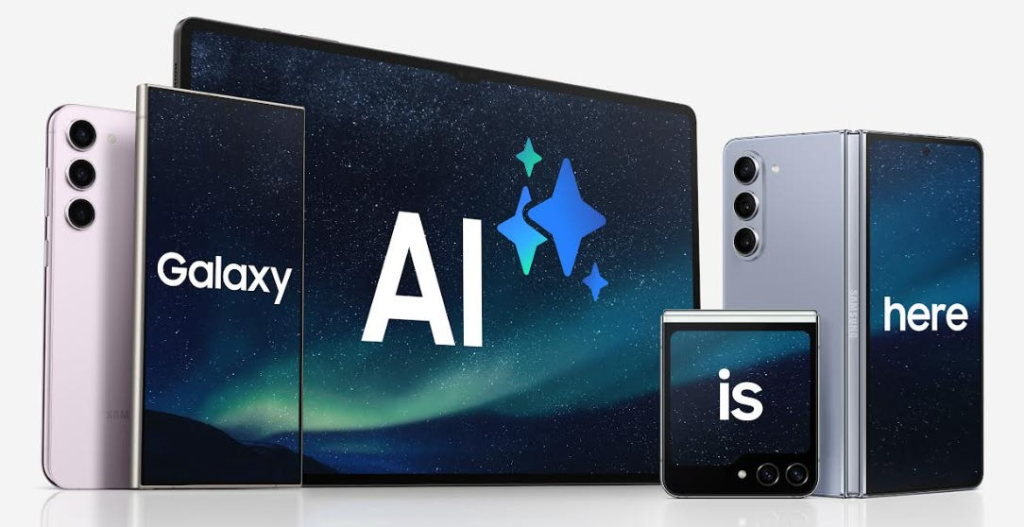
Because Google cannot beat Naver on “Koreanness,” it has deployed a Trojan Horse strategy through Samsung Electronics. The Galaxy S24 “AI Phone” is the linchpin of this gambit, allowing Google technology to wear a trusted Samsung mask.
The Multi-Tiered Architecture of the S24:
- Gemini Pro (Cloud): Powers high-complexity tasks like Note Assist, Voice Recorder summaries, and Keyboard intelligence.
- Imagen 2: Drives the “Generative Edit” feature, bringing Google’s creative R&D to the Samsung Gallery.
- Gemini Nano (On-Device): Ensures privacy and speed for localized tasks, bypassing the latency of the cloud.
This partnership allows Google to “leapfrog” localization hurdles by piggybacking on Samsung’s massive distribution network and brand equity, placing Gemini in the pockets of millions of Koreans who would otherwise never leave the Naver ecosystem.
6. The Architecture of Value: The Business Model Canvas
The “Galaxy AI” ecosystem represents a sophisticated Business Model Canvas that seeks to transition from hardware sales to recurring service revenue.
- Value Propositions: The hook is a fusion of productivity and creativity (Note Assist, Generative Edit). The on-device processing of Gemini Nano provides a security and speed advantage that cloud-only competitors cannot replicate.
- Key Partnerships: The triad of Google (Infrastructure), Samsung (Hardware), and carriers like LG U+ (Distribution) creates a defensive wall against regulatory and competitive pressure.
- Revenue Streams and the “Freemium” Risk: Currently, monetization is indirect through “Hardware Premiums.” However, 2025 marks the moment of truth: a projected transition to a subscription model for advanced features. In a market where B2C loyalty is low, Google risks losing users to Naver if those users refuse to pay a monthly fee for features they have come to expect as part of the hardware cost.
7. Strategic Synthesis: The Road to 2026
The “Peninsula Pivot” is far from a guaranteed success. As 2026 approaches, the Basic Act on AI will demand a level of transparency and local accountability that will test the limits of Google’s global flexibility. The tension between “Digital Sovereignty” and “Globalism” remains the defining conflict of the Korean market. Ultimately, the Google Gemini AI business model in South Korea reveals how AI strategy must balance localization, regulation, and ecosystem partnerships.
Google’s ultimate challenge is to prove that Gemini can evolve from a powerful foreign tool into a seamlessly Korean experience. While the Samsung partnership provides the distribution and LG U+ provides the integration, the technical and cultural gaps in localization remain an unresolved liability.
Whether Google’s pivot results in a localized empire or a high-cost retreat depends on its ability to close the KMMLU gap and navigate the 2026 regulatory minefield. In this technological Galapagos, Google’s survival depends on whether it can truly speak the language of the peninsula, or if it will remain a powerful alien force in a land that prizes its own digital sovereignty above all else.
Thank you for reading my article all the way to the end — I truly hope you found it valuable and insightful.
If you’d like to explore more helpful posts, feel free to My Blog